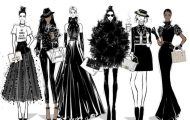
“Rihanna”
Who did this? Who is responsible for this profound statement ~~> Who gave life to a head covering garment a “Cloth” with a history that we don’t really want to be reminded of yet we must never ever forget the tribulations of Slavery. For it does not matter what shade of skin you have “Slavery” should never ever be forgotten {spoken}.
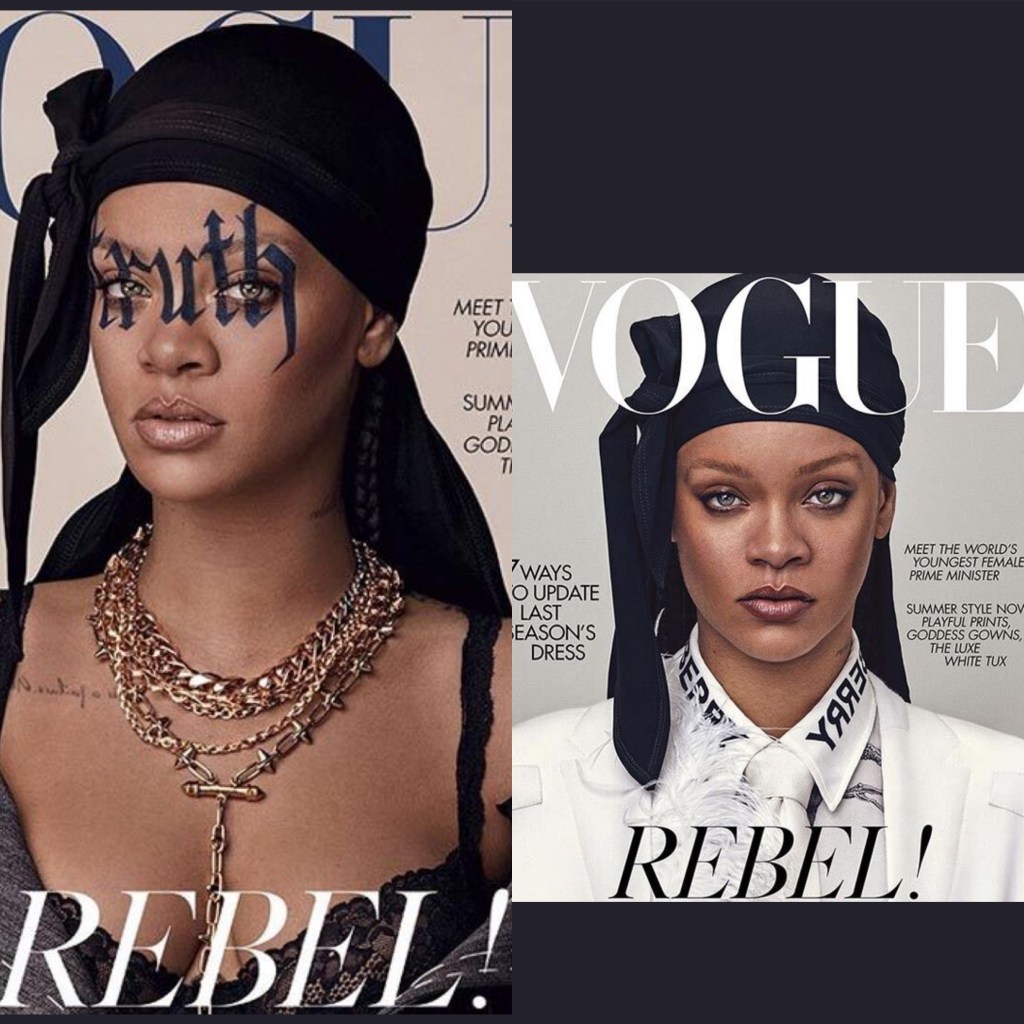
Rihanna wore the “Durag or Do~Rag”, the latter being the original form as it was worn by female black slaves, who I am guessing only wore this item whilst working as slaves hence why they named it the “do-rag”. Maybe wearing it when working was too hide from being recognised as a slave without it — who knows? Identified with as not a protective cloth but more of a distraction and not used to enhance or create an attractive look. Instead it drew away the from the true femininity of a black woman’s hair and of course beauty. In the 1930s, black women wore the Durag whilst working in labor roles during the Great Depression, https://www.history.com/topics/great-depression/great-depression-history#section_6 and it soon became used to maintain waves and curls in hairstyles. It was around this time it made its entrance as a fashion statement during the late 1960s, the Durag was worn by African Americans symbolic to the culture and then wrapped the heads of many hip-hop rappers, and was also visible in sports donned by soccer athletes worn under their helmets which still to this day makes a guess appearance on so many peoples heads, on street corners to celebrities, and now it has landed on the front cover of the “bible of luxury” VOGUE.
The person responsible can only be another creative mastermind in the world of fashion, who has since 2017 been inviting a different audience to the Royals of Fashion ~ VOGUE ~ https://www.vogue.co.uk/fashion/article/rihanna-first-durag-british-vogue-cover the one and only Mr Edward Kohima Enninful, OBE is the Editor~In~Chief of British Vogue. A man with his heritage from Ghana, who climbed the ranks at the tender age of 18, he was appointed the role of Fashion Editor at i-D magazine, and achieved a status that served him well and partly catapulted him into become the first male editor at Vogue. Clearly he is applying his achieved power to expand on a narrative that is worthy of global presence and representation in an industry that is slowly but surely becoming diverse. He is giving a history lesson in a subtle kind of way by using an item to provoke thought and of course the person wearing {Rihanna} it is sheer GENUIS, a master at work. Should we be accepting the evolution of the Durag ? Well, the message that I got from this is that “anything is possible and achievable” and “never give up” keep expanding as RiRi echoes this perception so loudly in her successes, which are never ending as she stamps her status/interests in a variety of industries and literally ‘kicks~aSS’ in everything she gives her attention too {I love her drive}.
The Story
To embrace and empower women of all colours, Rihanna has taken this “cloth” to another level and introduced it too us as a fashion accessory must have. Albeit a statement in disguise let’s be wise about this and take a moment to think about its origin and history “so let that sink in”.
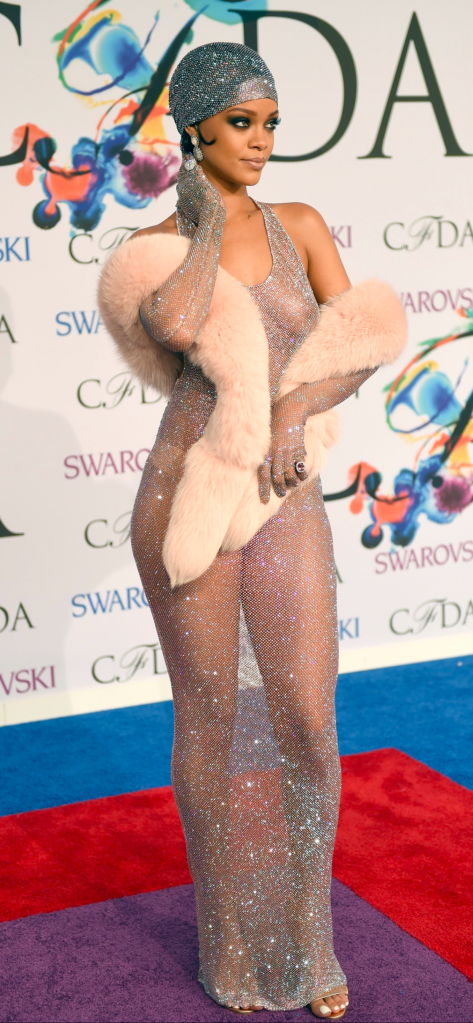
CFDA awards in 2014
Photo Shout: © TIMOTHY A. CLARY
Where did the Durag come from?
Of course the Durag has played a role in all people of colours lives, including my own and yes I have more than one in my hair section of my beauty room. But both women and men use this underrated hair accessory or item which ever one you choose to categorize it under. Men used it back in 80s I could probably say the 60s but I can honestly witness seeing the Durag on the heads of males from the 90s—>feel free to comment if you bared witness or even wore one back then. Anyway, men used it to hold the shape of the “waves” created with wave~wax like the infamous jar or tin of Dax a product which many are familiar with and was used was on the hair of women too.
But women of colour use the Durag to keep the hair in place especially cornrows or braids, and baby hair that tended to fluff~up after a nights sleep. Its use was for maintaining a style and reducing “hair~time” when getting ready for school/work/partying whatever your routine or mission the Durag has a played a significant role in the “beauty/bathrooms” of the majority if not all the lives of people of colour —> my Mama even has one now.
Memory Lane
Gosh.. Historically in the UK black Brits used the “tights-foot” which was an item used to flatten the hair/curls and keeps everything in place overnight. What a name though {hahahahaha}, it was a DIY job of a Durag and derived from the tops of any denier~old~laddered~tights being dismantled/cut off leaving the ends that cover the legs and feet detached from the thighs/waist section. A knot would be made basically tying the ends together, and this was used as a head cover mainly by black women {men used them too even though they’d never admit it on camera}. I actually grew up seeing my Mama use this to keep her hair in-place. Which miraculously did the job and in my life this was a hidden hair~tool which I am not ashamed to say that I would still use today but I wear stockings more than tights nowadays. It is really like a wig cap but with ends {uncontrollable giggles right now} which is where the “tights~foot” name tag came from.
Black Hair history lesson growing up in Britain
Brilliant creative mindsets {take a bow} who have gone unnoticed for decades who provided hair and beauty services for black people in prominent areas {London, Birmingham} of the U.K. that they migrated too heavily back in the 60’s. Where many families shared homes because the integration into communities was not easy therefore acquiring products and facilities for black~hair was zero for those living in U.K. However, hair salons and barber shops surfaced way before this huge gap in the lucrative beauty market was identified and filled. For whatever the reasons, this was another experience endured by the lack of acknowledgement by society, even though is what many black people had too resort to when there was no hair products or tools for the curly locks, only olive oil or vaseline ruled the waves, and if you was lucky to source brands like Dax and then Dark & Lovely which took the trophies of “luxury” hair products back then. Let’s not forget the original hair straightening tool of the trade: The hot hair comb which was a metal comb with a thick handle, which was heated on a gas fire flame, and administered to your curly locks to soften the curl and straighten the hair as too give it a more manageable desire too create and style. My Mama said when she was growing up rollers where old rags from stiff starched cotton used to roll straightened hair to give a looser curl before rods where created and available. It was unimaginable for me growing up wearing breads because hair-shops and cosmetics stores never catered for textured hair types, and the shelves never had a section for black peoples hair, and skin products specifically for oily skin was nonexistent. How times have changed the not so well off person’s version of hairstyling, but having zero hair products for curly hair to be styled gave these items an absolute revolutionary status in those days. My, my, haven’t times truly changed, and these secret hair weapons still exist. Now the “Durag” has taken a position and recognition in all ages, skin colours, and genders lives, as the~must~have hair~accessory item. And taken a place in the “hair~hall~of~fame” and has found its place on the front of a global magazine cover {strike a pose} VOGUE.
“Take a bow Rihanna ~~>thank you Edward for bringing so much culture, history, education and of course style to the forever growing and of course expanding Fashion narratives.”
Photo Shouts: vogue.co.uk vogue.com

 Fashion Brands Behaviour